
diffray vs HookMesh
Side-by-side comparison to help you choose the right AI tool.

diffray
Diffray provides precise AI code reviews with 30 agents to catch real bugs and reduce false positives.
Last updated: February 28, 2026

Effortlessly enhance your SaaS with reliable webhooks, automatic retries, and a self-service customer portal.
Last updated: February 26, 2026
Visual Comparison
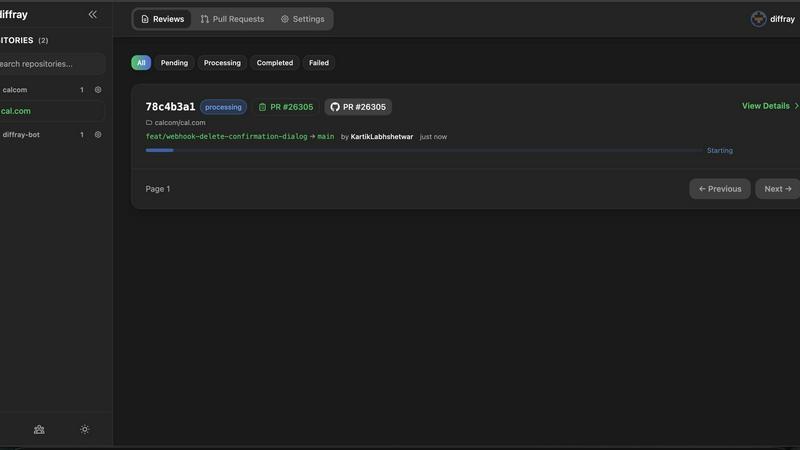
diffray
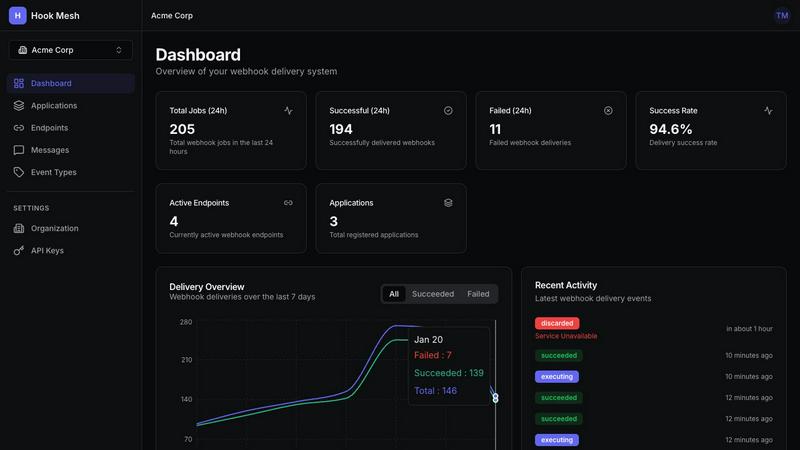
HookMesh
Feature Comparison
diffray
Multi-Agent Specialized Architecture
Unlike tools using one general model, diffray employs over 30 AI agents, each fine-tuned for a specific review category. This includes dedicated agents for security (e.g., SQL injection, XSS), performance (e.g., inefficient loops, memory leaks), bug detection, and coding best practices. This specialization ensures highly accurate, context-aware feedback directly relevant to the code being analyzed, which is the foundation for its low false-positive rate.
Drastic Reduction in False Positives
By leveraging its team of expert agents, diffray filters out generic and irrelevant warnings that plague other review tools. Teams experience up to 87% fewer false positive comments. This means developers receive only actionable, high-signal feedback, saving valuable time otherwise wasted on investigating non-issues and maintaining focus on meaningful code improvements.
Comprehensive Issue Detection
The coordinated effort of multiple specialized agents allows for deep, multi-faceted code analysis in a single pass. diffray scans for a wide spectrum of problems simultaneously—from critical security flaws and subtle bugs to performance anti-patterns and style guide violations. This comprehensive coverage helps teams catch three times more genuine issues early in the development cycle, preventing bugs from reaching production.
Seamless Integration & Accelerated Reviews
diffray integrates directly into existing development workflows and version control systems like GitHub. It automates the initial review pass on every pull request, providing instant, detailed comments. This automation accelerates the entire review cycle, reducing the average time developers spend on PR reviews from 45 minutes to just 12 minutes per week, freeing them for more creative and complex tasks.
HookMesh
Reliable Delivery
HookMesh guarantees that webhooks are never lost. The platform utilizes automatic retries with exponential backoff and jitter, allowing for retries over a 48-hour period. This ensures that even if a customer endpoint fails temporarily, the webhook will be delivered once the issue is resolved.
Circuit Breaker
This feature automatically disables failing endpoints when they do not respond correctly. By preventing a slow or unresponsive endpoint from backing up the entire queue, HookMesh enhances overall system performance. Once the endpoint recovers, it can be re-enabled seamlessly.
Customer Portal
HookMesh provides a self-service portal for customers to manage their endpoints effectively. This embeddable UI allows users to add endpoints, monitor delivery logs for full request/response visibility, and even replay failed webhooks instantly, enhancing user experience and reducing support requests.
Developer Experience
The platform is designed to enable developers to ship webhooks in just minutes. With a REST API and SDKs available for JavaScript, Python, and Go, HookMesh simplifies the integration process, allowing teams to send webhook events with minimal code and effort.
Use Cases
diffray
Accelerating Pull Request Workflows
Development teams use diffray to automate the first pass of code review on every pull request. The AI provides immediate, detailed feedback on security, bugs, and best practices the moment a PR is opened. This gives reviewers a head start and authors a chance to fix issues early, drastically cutting down the back-and-forth cycle and merging code faster with higher confidence.
Enforcing Code Quality at Scale
Engineering leaders and platform teams implement diffray to consistently enforce coding standards and security policies across large, distributed teams or multiple projects. The tool acts as an always-available, unbiased expert reviewer, ensuring every piece of code meets organizational benchmarks for quality, maintainability, and safety before human review even begins.
Onboarding Junior Developers
diffray serves as an invaluable training tool for new developers joining a team. It provides real-time, educational feedback on code, explaining best practices, potential pitfalls, and project-specific conventions. This accelerates the onboarding process, helps juniors write better code faster, and reduces the mentoring burden on senior engineers.
Proactive Technical Debt Management
Teams utilize diffray to proactively identify and address technical debt and code smells as they are introduced. By catching performance anti-patterns, duplication, and complex, hard-to-maintain code early, teams can refactor immediately, preventing small issues from accumulating into significant legacy debt that slows down future development.
HookMesh
E-commerce Notifications
E-commerce platforms can utilize HookMesh to send real-time notifications for events such as order completions, inventory updates, and shipping status changes. This ensures customers receive timely updates, enhancing their overall shopping experience.
SaaS Application Integrations
SaaS applications can leverage HookMesh to facilitate integrations with other services, enabling seamless data synchronization and real-time updates. This allows businesses to connect their applications with third-party services without worrying about webhook delivery failures.
Payment Processing
Payment gateways can use HookMesh to reliably send payment confirmation webhooks to merchants. By ensuring that these critical notifications are consistently delivered, businesses can enhance their transactional accuracy and customer trust.
System Monitoring Alerts
IT teams can implement HookMesh to send alerts and notifications about system status and performance. This proactive approach allows teams to quickly respond to issues, ensuring that systems remain operational and performance thresholds are met.
Overview
About diffray
diffray is an advanced AI-powered code review assistant engineered to transform the software development workflow. It moves beyond generic, single-model tools by implementing a sophisticated multi-agent architecture. This system deploys over 30 specialized AI agents, each an expert in a distinct domain such as security vulnerabilities, performance bottlenecks, bug patterns, language-specific best practices, and even SEO considerations for web code. This targeted, expert-driven approach is the core of diffray's value proposition: it dramatically increases the accuracy and relevance of feedback. The result is a dual benefit of drastically reducing noise and significantly improving issue detection. Teams report up to 87% fewer false positives, meaning developers spend less time sifting through irrelevant comments and more time fixing real problems. Concurrently, the tool helps catch three times more genuine, critical issues before they reach production. This efficiency slashes the time spent on pull request reviews, from an average of 45 minutes down to just 12 minutes per week per developer. diffray is built for development teams and engineering leaders who prioritize code quality, developer productivity, and streamlined processes, enabling them to ship robust software faster without compromising on standards.
About HookMesh
HookMesh is a cutting-edge solution aimed at simplifying webhook delivery for modern SaaS products. It navigates the complexities associated with in-house webhook management, including retry logic, circuit breakers, and debugging delivery issues. By leveraging HookMesh, businesses can concentrate on their core offerings without being encumbered by technical challenges related to webhook operations. The platform provides battle-tested infrastructure, ensuring dependable delivery through features like automatic retries, exponential backoff, and idempotency keys. HookMesh is perfect for developers and product teams striving to deliver a seamless customer experience while ensuring consistent and reliable webhook event delivery. Additionally, the self-service portal empowers customers with easy endpoint management and visibility, including the ability to replay failed webhooks with just a click, making HookMesh an essential tool for organizations seeking a robust webhook strategy.
Frequently Asked Questions
diffray FAQ
How does diffray achieve fewer false positives than other tools?
diffray uses a multi-agent system where over 30 specialized AI models, each an expert in a specific area like security or performance, analyze the code. This targeted approach allows for more precise, context-aware analysis compared to a single, generalized model. It filters out irrelevant warnings that don't apply to the specific code context, resulting in up to 87% fewer false positives.
What programming languages and frameworks does diffray support?
diffray is designed to support a wide range of popular programming languages and web frameworks. While the exact list evolves, it typically includes comprehensive support for JavaScript/TypeScript, Python, Java, Go, PHP, Ruby, and their major associated frameworks. The specialized agents are trained on language-specific patterns and best practices.
How does diffray integrate with our existing development tools?
diffray integrates seamlessly into your existing workflow through direct integrations with GitHub and other major version control platforms. It typically operates via a GitHub App or similar, automatically scanning pull requests and posting review comments directly on the code diff, requiring minimal setup and no context switching for developers.
Is my source code kept private and secure when using diffray?
Yes, code security and privacy are paramount. diffray is designed with enterprise-grade security practices. Code analysis is performed in a secure, isolated environment, and the tool adheres to strict data privacy policies. It does not retain your source code for training purposes, ensuring your intellectual property remains confidential and protected.
HookMesh FAQ
What is HookMesh used for?
HookMesh is used to simplify and enhance webhook delivery for SaaS products, addressing challenges such as retry logic and endpoint management, ultimately enabling reliable communication between systems.
How does HookMesh ensure reliable delivery of webhooks?
The platform employs automatic retries, exponential backoff, and circuit breakers to manage webhook deliveries. This means that if an endpoint fails, HookMesh will attempt to resend the webhook over a specified time period.
Can I manage my webhook endpoints easily?
Yes, HookMesh provides a self-service customer portal that allows users to add, manage, and monitor their webhook endpoints. Users can view delivery logs and replay any failed webhooks with ease.
What programming languages does HookMesh support?
HookMesh offers SDKs for JavaScript, Python, and Go, making it easy for developers to integrate webhook functionality into their applications with just a few lines of code.
Alternatives
diffray Alternatives
diffray is an advanced AI code review tool in the software development category. It uses a specialized multi-agent system to analyze code for bugs, security, and best practices, aiming to drastically cut review time and false positives. Users often explore alternatives for various reasons. These can include budget constraints, the need for different feature sets, specific integration requirements with their tech stack, or simply a desire to evaluate the market before committing to a solution. When considering an alternative, key factors to assess include the accuracy of feedback and false positive rate, the depth of codebase context and understanding, the quality and actionability of suggestions, and the ease of integration with your existing development workflow and platforms.
HookMesh Alternatives
HookMesh is a specialized platform designed to enhance webhook delivery for Software as a Service (SaaS) products. It simplifies the complexities associated with in-house webhook management by offering features like automatic retries, reliable delivery mechanisms, and a self-service customer portal. Users often seek alternatives to HookMesh due to varying needs, such as budget constraints, specific feature requirements, or preferences for integration with existing platforms. When choosing an alternative, it is crucial to evaluate aspects like reliability, ease of use, support options, and the overall fit for your team's technical capabilities. In the search for webhook delivery solutions, businesses should prioritize platforms that offer robust delivery guarantees, a user-friendly interface for management, and comprehensive logging capabilities. Additionally, consider the scalability of the solution to ensure it meets future growth requirements and the flexibility provided for integrating with other tools and services in your tech stack.