
Deeploy vs iGPT
Side-by-side comparison to help you choose the right AI tool.

Deeploy
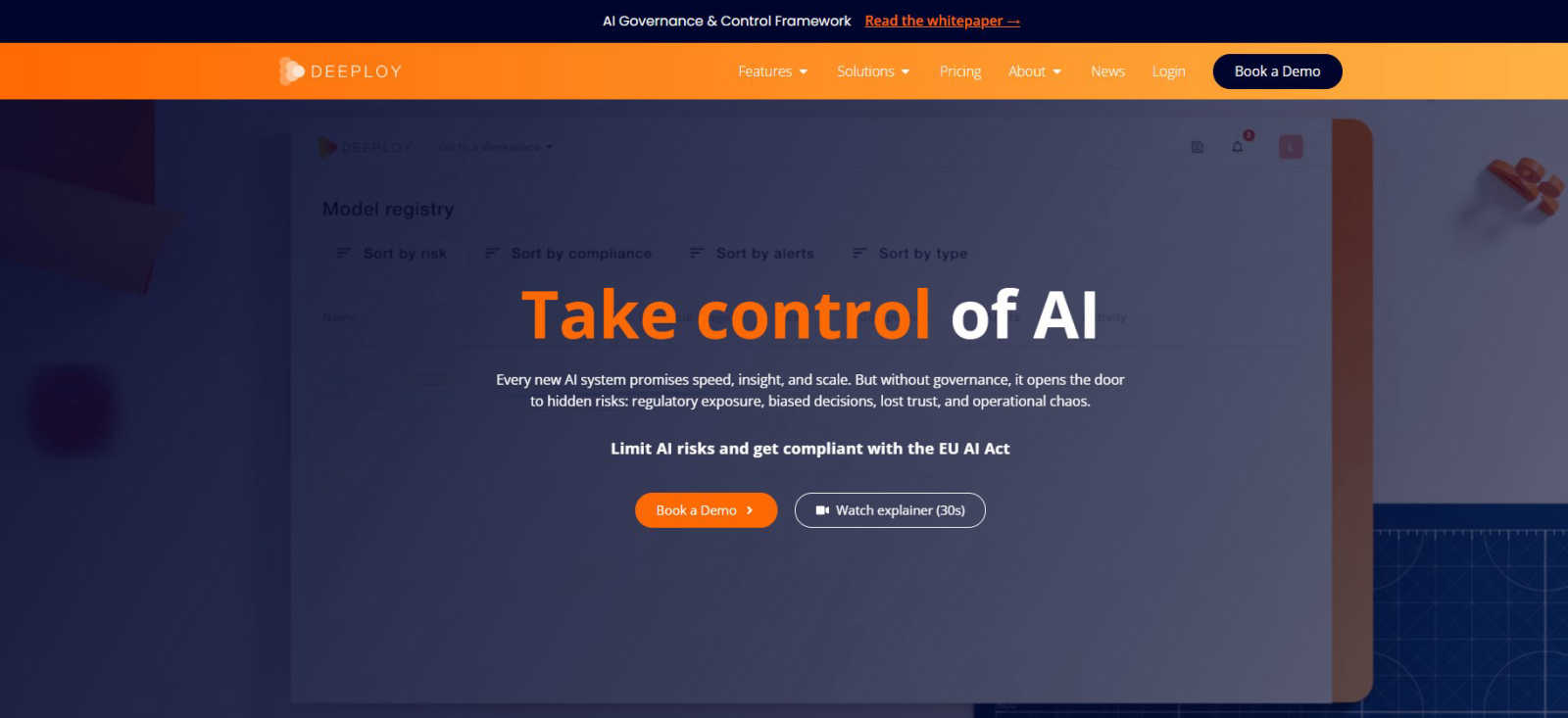
Deeploy enables organizations to govern AI systems effectively, ensuring compliance and reducing risk while scaling.
Last updated: March 1, 2026

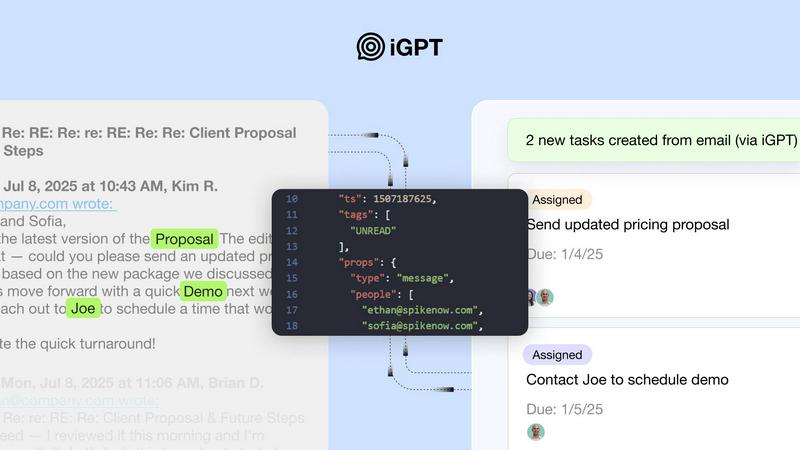
iGPT gives AI agents secure, context-aware answers from your team's email data.
Last updated: February 28, 2026
Visual Comparison
Deeploy
iGPT
Feature Comparison
Deeploy
AI Discovery and Onboarding
Deeploy provides complete visibility across your AI landscape. It allows organizations to discover, onboard, and manage every AI system from one intuitive interface, eliminating blind spots and ensuring centralized control without migration complications.
Control Frameworks
Navigate AI regulations effortlessly with Deeploy’s guided workflows. Users can choose from default control frameworks, such as ISO 42001 and NIST AI RMF, or create custom ones, allowing for quick classification of AI system risk and establishing clear accountability.
Control Implementation
Deeploy transforms governance frameworks into enforceable controls, ensuring that every AI system adheres to the right requirements with minimal manual input. Engineers receive clear, actionable requirements, significantly accelerating compliance processes.
Real-time Monitoring
Monitor AI performance in real-time to prevent incidents before they occur. Deeploy provides instant alerts for model drift or performance drops, allowing organizations to identify errors and anomalies proactively, thereby safeguarding compliance and user experience.
iGPT
Unified Contextual Endpoint
Replace complex multi-step retrieval systems with a single natural language API request. iGPT's unified endpoint seamlessly handles retrieval, context shaping, and reasoning in one integrated pipeline, delivering answers ready for automation without any prompt engineering or manual pipeline management required.
Deep Email & Attachment Processing
iGPT automatically and deeply indexes all email data, including complex threads with multiple participants. It also processes attachments, extracting text, data, and structure from documents, PDFs, and spreadsheets to provide a complete view of the conversation's context and content.
Hybrid Retrieval with Citations
The system employs a sophisticated hybrid retrieval method combining semantic, keyword, and filtered search, which is then scored and re-ranked in one call. Every answer is returned with direct citations back to the source emails and attachments, ensuring verifiability and trust.
Enterprise-Grade Security & Auditability
Built with strict security principles, iGPT offers zero data training, OAuth-only processing with Role-Based Access Control (RBAC), and zero data retention. Each inference is processed in memory, and a full audit trail ensures all actions are traceable, keeping data under your company's control.
Use Cases
Deeploy
Optimizing AI Oversight
Organizations can utilize Deeploy to gain comprehensive control over dispersed AI systems, consolidating their AI inventory and ensuring compliance with evolving regulations.
Enhancing Compliance Processes
Deeploy simplifies compliance with AI regulations by providing guided workflows, enabling teams to navigate complex requirements without overwhelming complexity.
Streamlining Model Deployment
Data scientists can deploy models rapidly, reducing deployment times from days or weeks to mere hours, while ensuring transparency and observability for both technical and non-technical stakeholders.
Supporting Ethical AI Practices
By integrating human feedback loops and explainability features, Deeploy allows organizations to ensure responsible AI usage, particularly in sensitive environments like healthcare and finance.
iGPT
Intelligent Email Assistants
Build AI agents that can draft, prioritize, summarize, and act on emails with a complete understanding of the entire thread history, participant roles, and attached documents, dramatically improving productivity and response quality.
Customer Support Copilots
Empower support teams with agents that instantly reconstruct the full customer story across long, messy email chains. These copilots can understand tone shifts, track issues, and reference attachments to provide accurate, context-rich support.
Workflow & CRM Automation
Automatically turn email conversations into structured data for other systems. Extract action items, deadlines, approvals, and deal momentum to create tasks in project tools or update records in CRM platforms like Salesforce, directly from email threads.
Compliance & Audit Trail Generation
Automate the tracking of critical communications for legal and regulatory compliance. iGPT can trace feedback, decisions, approvals, and rationale back to the original email and attachment sources, creating a reliable and searchable audit trail.
Overview
About Deeploy
Deeploy is a comprehensive AI governance software that centralizes oversight, compliance, and monitoring for all AI systems within an organization. As businesses increasingly leverage AI technologies, the demand for effective governance becomes paramount to mitigate risks and ensure alignment with regulatory standards, such as the EU AI Act. Deeploy empowers organizations to manage their AI landscape from a single interface, allowing real-time explainability, human feedback, and robust audit trails. Its flexible onboarding process enables seamless integration with existing MLOps or GenAI platforms, ensuring complete visibility and control over AI initiatives. The primary value proposition of Deeploy lies in its ability to simplify compliance, enhance transparency, and enable organizations to scale their AI efforts confidently while maintaining oversight.
About iGPT
iGPT is an enterprise-grade email intelligence API that transforms the unstructured data within email communications and attachments into structured, actionable intelligence for AI agents and automated workflows. It solves a critical gap where most AI systems fail: reliably accessing and understanding the complex context of email threads, documents, and historical conversations. Designed for developers and enterprises, iGPT provides a secure, unified gateway to deep email context through a single API call. This eliminates the immense engineering burden of building and maintaining custom pipelines for parsing, chunking, indexing, and prompt tuning. By delivering trusted, context-aware answers with full citations, iGPT enables businesses to confidently deploy intelligent automation for sales, customer support, operations, and compliance, turning the chaos of email into a powerful, structured data source.
Frequently Asked Questions
Deeploy FAQ
What kind of organizations can benefit from Deeploy?
Deeploy is designed for any organization that utilizes AI technologies, particularly those facing regulatory scrutiny or needing centralized oversight to manage compliance and risk.
How does Deeploy ensure compliance with regulations?
Deeploy provides guided workflows and customizable control frameworks that help organizations navigate complex AI regulations, ensuring compliance is straightforward and efficient.
Can Deeploy integrate with existing systems?
Yes, Deeploy features a flexible onboarding process that allows seamless integration with existing MLOps or GenAI platforms, ensuring no disruption to current operations.
What are the benefits of real-time monitoring?
Real-time monitoring helps organizations detect and address AI performance issues proactively. This feature minimizes compliance risks and enhances user trust by ensuring consistent AI performance.
iGPT FAQ
How does iGPT handle data privacy and security?
iGPT is built on a foundation of enterprise-grade security. It practices zero data training, meaning your data is never used to train models. It uses OAuth-only processing with RBAC, enforces zero data retention (processing happens in memory), and provides a full audit trail, ensuring data never leaves your control.
What makes iGPT different from using a generic LLM on email text?
Generic LLMs lack the specialized understanding of email structure, threading, and attachment context. iGPT provides a complete pipeline that deeply indexes, reconstructs threads, processes attachments, and performs optimized retrieval to deliver accurate, cited answers from messy email data through one simple call, eliminating months of custom engineering.
Can iGPT process data from multiple email sources?
Yes, iGPT is designed to connect to and unify data from various enterprise email sources. It deeply indexes emails and attachments from these connected sources, allowing a single API query to retrieve context from across all of them, creating a unified intelligence layer.
What is the Context Engineering Framework (CEF)?
The Context Engineering Framework (CEF) is iGPT's performance and quality tier system. It allows developers to choose the optimal balance of speed, cost, and reasoning depth for their specific use case by selecting different CEF tiers (e.g., cef-1-normal) when making an API request.
Alternatives
Deeploy Alternatives
Deeploy is a comprehensive AI governance software that centralizes oversight, compliance, and monitoring for AI systems within organizations. As businesses increasingly adopt AI technologies, the need for effective governance becomes essential to mitigate risks and ensure adherence to regulatory standards. Users often seek alternatives to Deeploy due to various factors, including pricing, specific feature sets, or the need for compatibility with existing platforms. When exploring alternatives, it is crucial to consider features such as AI discovery and onboarding capabilities, control frameworks, and ease of integration with current MLOps or GenAI systems. Users should also evaluate how well an alternative can simplify compliance, enhance transparency, and support scalability in their AI initiatives.
iGPT Alternatives
iGPT is an enterprise-grade email intelligence API that transforms unstructured email and attachment data into structured, context-aware answers for AI agents and workflows. It belongs to the business intelligence category, specifically solving for secure, reliable access to team communication data. Users may look for alternatives for various reasons, including budget constraints, specific feature requirements not covered, or a need for a different deployment model. Some may seek a broader platform or a solution integrated into an existing tech stack. When evaluating alternatives, consider core capabilities like depth of email and attachment processing, security and compliance standards, ease of API integration, and the system's ability to deliver accurate, contextual answers from complex communication threads.