
Agenta vs Fallom
Side-by-side comparison to help you choose the right AI tool.

Agenta is an open-source platform that streamlines LLM app development with integrated prompt management and evaluation.
Last updated: March 1, 2026

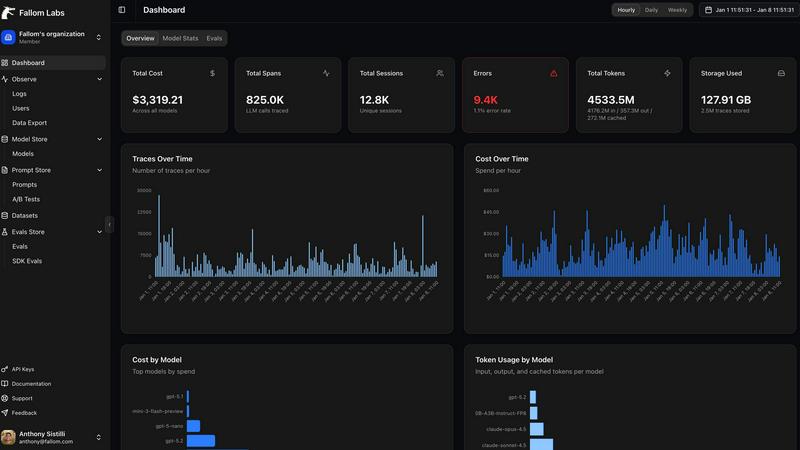
Fallom offers real-time observability for AI agents, tracking costs and performance to enhance debugging and compliance.
Last updated: February 28, 2026
Visual Comparison
Agenta

Fallom
Feature Comparison
Agenta
Centralized Management
Agenta centralizes prompts, evaluations, and trace data, providing a unified platform that enhances collaboration among team members. This eliminates the confusion of scattered documents across various tools and fosters a structured approach to LLM development.
Unified Experimentation Playground
The platform features a unified playground where teams can compare prompts and models side-by-side. This allows for quick iterations and testing, ensuring that teams can validate changes effectively and maintain complete version history.
Automated Evaluation Systems
Agenta automates the evaluation process, enabling teams to systematically run experiments, track outcomes, and validate changes. This reduces guesswork and provides evidence-based insights into performance improvements.
Observability and Debugging Tools
With robust observability tools, Agenta allows teams to trace every request and pinpoint exact failure points in their systems. Annotating traces and turning any trace into a test with a single click streamlines the debugging process.
Fallom
Real-Time Observability
Fallom provides real-time observability for AI agents, enabling users to track tool calls, analyze timing, and debug interactions with confidence. This feature ensures that teams can quickly identify and resolve issues, enhancing overall system performance.
Session-Level Context
With session-level context, Fallom allows users to group traces by session, user, or customer. This feature provides complete context for every interaction, making it easier to trace issues back to specific users or sessions and improving troubleshooting efficiency.
Cost Attribution
Fallom's cost attribution feature enables teams to track spending on a per-model, per-user, or per-team basis. This transparency aids in budgeting and chargeback processes, ensuring that organizations maintain control over their AI-related expenses.
Compliance and Audit Trails
Fallom is designed to meet regulatory requirements with comprehensive audit trails. The platform supports essential compliance measures such as the EU AI Act, SOC 2, and GDPR, ensuring organizations are prepared for audits and maintaining user trust.
Use Cases
Agenta
Streamlined Team Collaboration
Agenta is ideal for teams that need to collaborate effectively across different roles. Product managers, developers, and domain experts can work together seamlessly within the same platform, reducing silos and improving workflow efficiency.
Efficient Prompt Management
Agenta allows teams to manage prompts efficiently, enabling quick iterations and version control. By centralizing prompt management, teams can avoid redundancy and maintain a clear history of changes, ensuring that everyone is on the same page.
Enhanced Evaluation Processes
Teams can leverage Agenta's automated evaluation systems to replace guesswork with data-driven insights. This is particularly useful for organizations that require rigorous testing to validate the performance of their LLM applications.
Robust Debugging Capabilities
When issues arise in production, Agenta's observability features help teams quickly diagnose problems. With the ability to trace requests and annotate data, teams can gather feedback efficiently and close the feedback loop to enhance product performance.
Fallom
Debugging AI Interactions
Teams can leverage Fallom to debug AI interactions efficiently. By providing detailed traces and session-level context, engineers can swiftly identify the root causes of issues, reducing downtime and improving user experience.
Performance Optimization
Fallom allows organizations to optimize the performance of their AI applications by analyzing real-time data on latency and tool call efficiency. This capability enables teams to fine-tune their systems for faster and more reliable interactions.
Cost Management
With built-in cost attribution features, organizations can manage and analyze their AI spending effectively. This helps teams allocate budgets accurately and make informed decisions regarding model usage and resource allocation.
Regulatory Compliance
Fallom supports organizations operating in regulated industries by providing full audit trails and privacy controls. This functionality helps businesses comply with necessary regulations while maintaining user data security and privacy.
Overview
About Agenta
Agenta is an open-source LLMOps platform tailored for AI teams seeking to build and deploy reliable large language model (LLM) applications. It addresses the inherent unpredictability of LLMs by creating a centralized, collaborative space that facilitates the entire development lifecycle. Designed for cross-functional teams that include developers, product managers, and subject matter experts, Agenta streamlines workflows that are often chaotic and siloed. Its core value proposition lies in unifying essential aspects of LLM development—experimentation, evaluation, and observability—into a single, accessible source of truth. This integration enables teams to systematically compare prompts and models, conduct both automated and human evaluations, and resolve production issues with actual trace data. With seamless integration into popular frameworks like LangChain and LlamaIndex, Agenta ensures model-agnostic capabilities, preventing vendor lock-in while expediting the deployment of robust, high-performance AI products.
About Fallom
Fallom is an AI-native observability platform tailored for monitoring and managing large language model (LLM) and AI agent workloads in production environments. It offers engineering and product teams unparalleled real-time visibility into every AI interaction, ensuring optimal performance and reliability. With a single OpenTelemetry-native SDK, users can easily instrument their applications within minutes to track every LLM call, complete with detailed traces of prompts, outputs, tool calls, tokens, latency, and per-call costs. Fallom is designed for teams focused on AI development who require rapid debugging, performance optimization, cost control, and robust audit trails to meet security and regulatory standards. Supporting all major model providers, Fallom ensures no vendor lock-in while providing the granular insights necessary for delivering reliable and cost-effective AI applications.
Frequently Asked Questions
Agenta FAQ
What types of teams can benefit from Agenta?
Agenta is designed for cross-functional teams, including developers, product managers, and subject matter experts, who are involved in the development and deployment of LLM applications.
How does Agenta ensure model-agnostic capabilities?
Agenta integrates seamlessly with various frameworks such as LangChain and LlamaIndex, allowing teams to utilize the best models from any provider without being locked into a single vendor.
Can I integrate my existing tools with Agenta?
Yes, Agenta supports integration with a wide range of tools and frameworks, providing full API and UI parity to ensure that programmatic and user interface workflows are centralized.
Is Agenta truly open-source?
Yes, Agenta is an open-source platform, allowing developers to dive into the code, contribute to its development, and benefit from the transparency that comes with open-source software.
Fallom FAQ
What is Fallom used for?
Fallom is used for monitoring and managing LLM and AI agent workloads in production. It provides real-time visibility, debugging tools, and compliance features, helping teams optimize performance and manage costs.
How does Fallom ensure compliance?
Fallom ensures compliance by offering comprehensive audit trails, input/output logging, model versioning, and user consent tracking. It is designed to meet regulatory requirements such as the EU AI Act and GDPR.
Can Fallom be used with any AI model provider?
Yes, Fallom supports all major model providers, ensuring that users can utilize the platform without being locked into a specific vendor. This flexibility allows for a more adaptable AI deployment strategy.
How quickly can I set up Fallom?
Setting up Fallom is quick and straightforward. The platform is OpenTelemetry-native, allowing users to instrument their applications in under five minutes, making it accessible for teams of all sizes.
Alternatives
Agenta Alternatives
Agenta is an open-source platform designed for LLMOps, enabling teams to build and manage reliable LLM applications. It centralizes the development lifecycle, addressing the unpredictability often associated with large language models by fostering collaboration among developers, product managers, and subject matter experts. Users commonly seek alternatives due to factors like pricing, feature sets, platform compatibility, and specific project requirements. When evaluating alternatives, consider the platform's flexibility, integration capabilities, and how well it supports the needs of cross-functional teams.
Fallom Alternatives
Fallom is an AI-native observability platform designed for monitoring and managing LLM and AI agent workloads in production. It provides engineering and product teams with comprehensive, real-time insights into every interaction with AI, ensuring that performance can be optimized and costs effectively controlled. Users often seek alternatives to Fallom due to various reasons, including pricing structures that may not align with their budget, the need for additional features or specific integrations, and varying platform requirements that may necessitate a different solution. When searching for an alternative to Fallom, consider the features that are most relevant to your needs, such as end-to-end tracing, compliance capabilities, and cost tracking. Look for platforms that offer similar functionalities to maintain visibility and control over AI interactions while ensuring that they can integrate seamlessly with your existing workflows and systems.