
Agent to Agent Testing Platform vs LLMWise
Side-by-side comparison to help you choose the right AI tool.

Agent to Agent Testing Platform
Validate AI agent behavior across chat, voice, and phone systems to ensure performance, security, and compliance.
Last updated: February 26, 2026

Access 62+ AI models with one API, auto-routing prompts to the best options without subscriptions, just pay as you go.
Last updated: February 26, 2026
Visual Comparison
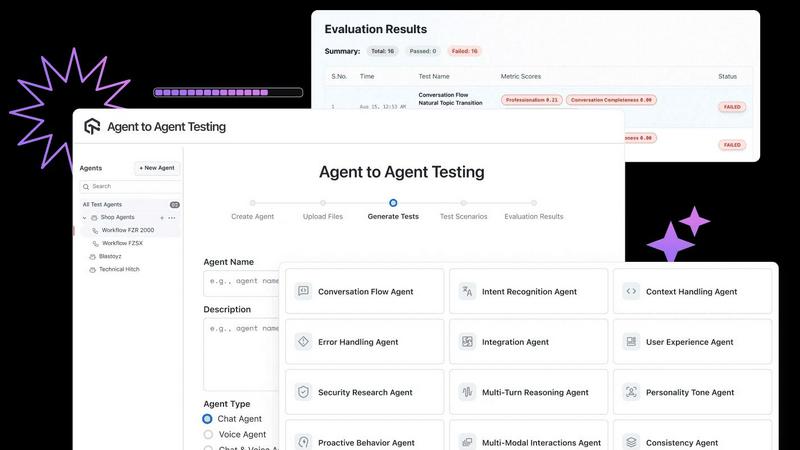
Agent to Agent Testing Platform
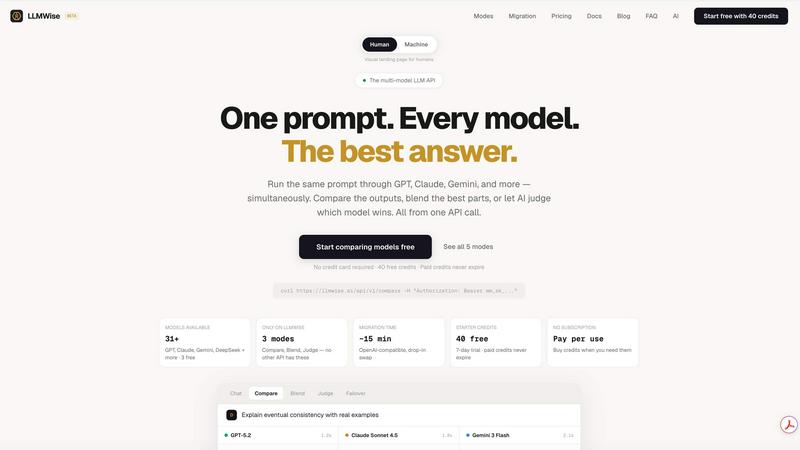
LLMWise
Feature Comparison
Agent to Agent Testing Platform
Automated Scenario Generation
This feature enables the creation of diverse and comprehensive test scenarios for AI agents, simulating interactions across chat, voice, and phone modalities. It allows for the testing of various scenarios to ensure the agents respond effectively in different contexts.
Multi-Agent Test Generation
Utilizing 17+ specialized AI agents, this feature uncovers long-tail failures, edge cases, and interaction patterns that traditional manual testing might overlook. This multi-agent approach enhances the robustness of testing outcomes.
Diverse Persona Testing
By leveraging a variety of personas that simulate different user behaviors and needs, this feature ensures that AI agents perform effectively for a broad range of user types. It helps in validating user interactions and enhancing the relevance of responses.
Regression Testing with Risk Scoring
This feature allows for comprehensive end-to-end regression testing of AI agents. It provides insights into potential risks, highlighting critical areas that require attention, thereby optimizing testing efforts and improving overall agent reliability.
LLMWise
Smart Routing
LLMWise features intelligent routing that automatically directs prompts to the optimal model. For example, coding queries are sent to GPT, while creative writing prompts go to Claude, and translation tasks are assigned to Gemini. This ensures that every request is handled by the most capable model, enhancing the quality of responses.
Compare & Blend
This feature allows users to run prompts across multiple models simultaneously, enabling side-by-side comparisons. The blending function combines the best parts of each model's output into a single, stronger response. This is particularly useful for generating high-quality content or making critical decisions based on the best insights from different models.
Always Resilient
LLMWise includes a circuit-breaker failover system that automatically reroutes requests to backup models if a primary provider goes down. This ensures that applications remain operational at all times, significantly reducing downtime and maintaining reliability.
Test & Optimize
Developers can take advantage of comprehensive benchmarking suites, batch tests, and optimization policies tailored for speed, cost, or reliability. Automated regression checks help maintain performance standards and ensure that applications remain efficient and effective over time.
Use Cases
Agent to Agent Testing Platform
Ensuring Compliance with Standards
Enterprises can utilize this platform to ensure that AI agents meet industry compliance standards by testing for bias and toxicity in conversations. This is crucial for maintaining ethical AI practices.
Testing for Conversational Flow
Businesses can assess the conversational flow of AI agents in various scenarios to enhance user experience. This ensures that the AI responds fluidly and accurately in multi-turn dialogues.
Validating Performance Across Modalities
Organizations can validate AI performance across different modalities, such as text, voice, and hybrid interactions. This allows for comprehensive testing of agents designed for specific user interaction channels.
Enhancing AI Agent Training
The insights gained from testing can be used to refine and retrain AI agents. This iterative process enhances the agents’ capabilities and ensures they are better equipped to handle real-world interactions.
LLMWise
Application Development
Developers can utilize LLMWise to create applications that require diverse AI functionalities. By accessing multiple models through a single API, they can build more sophisticated features without the overhead of managing different systems.
Content Creation
Writers and marketers can leverage LLMWise to generate high-quality content. By using the compare and blend features, they can produce articles, social media posts, and marketing materials that leverage the strengths of various LLMs.
Data Analysis
Analysts can use LLMWise to process and interpret large datasets. By routing data queries to the most appropriate model, they can obtain insights and generate reports more efficiently, improving decision-making processes.
Language Translation
Businesses operating in multiple regions can rely on LLMWise for accurate and context-aware translations. By utilizing its routing capabilities, they can choose the best model for language translation tasks, ensuring clarity and accuracy in communication.
Overview
About Agent to Agent Testing Platform
Agent to Agent Testing Platform is a revolutionary AI-native quality assurance framework designed specifically to validate the performance and behavior of AI agents in real-world environments. In a landscape where AI systems are becoming increasingly autonomous and unpredictable, traditional quality assurance models fall short. This platform transcends basic prompt checks, allowing enterprises to assess full, multi-turn conversations across diverse modalities such as chat, voice, and phone interactions. Its primary value proposition lies in ensuring that AI agents function correctly before they are deployed, thereby reducing potential risks and enhancing user experience. With the ability to identify long-tail failures and edge cases through a dedicated assurance layer, this platform equips businesses with the tools necessary to maintain high standards of AI performance.
About LLMWise
LLMWise is a revolutionary AI integration platform that streamlines access to multiple large language models (LLMs) through a single API. By aggregating major providers like OpenAI, Anthropic, Google, Meta, xAI, and DeepSeek, LLMWise eliminates the hassle of managing various subscriptions and keys. It intelligently routes prompts to the most suitable model based on task requirements—whether it's coding, creative writing, or translation. This versatility allows developers to optimize their applications without the complexity of juggling different APIs. With features like side-by-side comparisons, blending outputs, and failover resilience, LLMWise is designed for developers who demand the best AI solutions across tasks without incurring unnecessary costs. Its flexible pricing model permits pay-as-you-go usage, ensuring that you only pay for what you need.
Frequently Asked Questions
Agent to Agent Testing Platform FAQ
What is agent to agent testing?
Agent to agent testing is a specialized framework designed to evaluate the behavior and performance of AI agents in real-world scenarios, ensuring quality and reliability before deployment.
How does the platform ensure quality?
The platform employs multi-agent test generation and automated scenario creation to thoroughly assess AI agents, identifying potential failures and edge cases that may not be apparent through manual testing.
Can the platform test multiple interaction modes?
Yes, the Agent to Agent Testing Platform is designed to evaluate AI agents across various interaction modes, including chat, voice, and phone calls, ensuring comprehensive performance validation.
Is the platform suitable for enterprises of all sizes?
Absolutely. The platform is tailored for enterprises of all sizes looking to enhance the performance and reliability of their AI agents, making it a valuable tool in any organization’s tech stack.
LLMWise FAQ
What models does LLMWise support?
LLMWise provides access to over 62 models from 20 different providers, including major names like OpenAI, Anthropic, Google, Meta, and more.
How does the pricing work?
LLMWise operates on a pay-as-you-go model, allowing users to only pay for the credits they use. There are also 30 free models available for unlimited testing and fallback options without any charges.
Can I use my existing API keys?
Yes, LLMWise supports a "Bring Your Own Key" (BYOK) feature, enabling users to integrate their existing API keys for various providers, ensuring flexibility and cost management.
How quickly can I get started with LLMWise?
Getting started is straightforward: sign up for an account, obtain your API key, and begin making requests within minutes. The platform is designed to be user-friendly and efficient for developers.
Alternatives
Agent to Agent Testing Platform Alternatives
The Agent to Agent Testing Platform is an innovative AI-native quality and assurance framework designed to validate agent behavior in real-world interactions across chat, voice, phone, and multimodal systems. It belongs to the category of AI Assistants, specifically focusing on ensuring the reliability and compliance of AI-driven agents as they operate autonomously. Users often seek alternatives due to factors such as pricing constraints, specific feature requirements, or compatibility with existing platforms. When exploring alternatives, it is essential to consider aspects like the comprehensiveness of testing capabilities, ease of integration, scalability, and support for various interaction modes to ensure that the chosen solution meets organizational needs efficiently.
LLMWise Alternatives
LLMWise is an innovative API platform that provides seamless access to multiple large language models (LLMs) such as GPT, Claude, and Gemini. It falls under the AI Assistants category, streamlining the process of utilizing various AI technologies without needing to manage multiple providers. Users commonly seek alternatives to LLMWise for reasons such as pricing, specific feature sets, or compatibility with their existing systems. When choosing an alternative, it's crucial to consider aspects like model coverage, ease of integration, reliability, and flexibility in pricing to ensure it meets your unique requirements.