

AI tool Details
Explore More
Alternatives
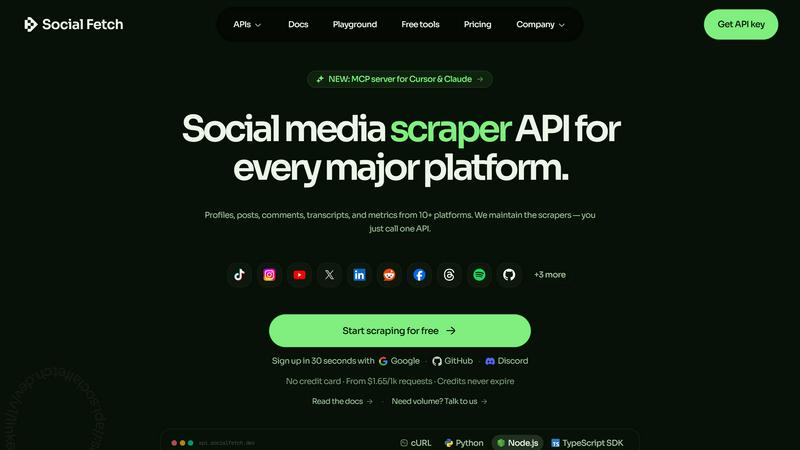
About Social Fetch
Social Fetch is a competitive intelligence API and social media monitoring API built for teams that need to track rivals, analyze ad strategies, and monitor content across the major social platforms. It provides a single, unified interface to scrape data from Facebook Ad Library search, TikTok Ads, Google Ads Transparency, and competitor social media profiles, posts, engagement metrics, and hashtag or keyword searches. The output is structured JSON, designed to feed directly into dashboards, alerting systems, and reporting pipelines without additional transformation.
The core value proposition is simplicity and reliability. Social Fetch uses consistent field naming across all supported platforms, which means your parsers and data models work the same way whether you are pulling data from YouTube, Instagram, TikTok, Twitter, or LinkedIn. Cursor-based pagination handles large datasets efficiently, and documented credit costs per endpoint make forecasting and budgeting straightforward. Live fetches ensure that your ad-spy and social media intelligence reports reflect campaigns running right now, not stale exports from days ago.
Social Fetch is for product teams, marketing analysts, growth hackers, and data engineers who need to track competitor content velocity, creative formats, engagement shifts, and trending hashtags at scale. It includes video transcript API routes and comment scraping, which feed directly into AI summarization workflows for qualitative analysis, eliminating the need for a separate extraction stack. The platform replaces weeks of proxy setup, browser automation, and marketplace maintenance with one API key, an OpenAPI specification, a TypeScript SDK, 100 free credits to start, and pay-as-you-go scaling. If your product depends on measuring what competitors publish publicly, Social Fetch is the social scraping API built for ad intelligence and competitive tracking.
Features
Unified Social Media Scraper API
Access data from 17 social media platforms through a single API endpoint with consistent field naming. Every request returns structured JSON with the same schema patterns, so your parsers and data pipelines work identically whether you are fetching a YouTube channel, an Instagram profile, a TikTok user, a Twitter account, or a LinkedIn profile. This eliminates the need to maintain separate scrapers or adapters for each platform, saving weeks of development time and reducing ongoing maintenance overhead.
Live Data Fetches
Every API request fetches data in real-time from the target platform, not from a cached or stale database. This means your ad intelligence reports, competitor profile snapshots, and engagement metrics always reflect the current state of campaigns and content. When a competitor launches a new ad on Facebook or changes their bio on Instagram, your systems see it immediately. This live approach is critical for time-sensitive use cases like ad-spy, crisis monitoring, and rapid competitive response.
Video Transcript and Comment Scraping
Extract full video transcripts and comment threads from supported platforms directly through the API. This data feeds into AI summarization, sentiment analysis, and qualitative research workflows without requiring a separate extraction stack. You can analyze the language competitors use in their video content, identify common themes in audience comments, and track sentiment shifts over time. The transcript and comment data uses the same consistent field naming, so it integrates seamlessly with your existing pipelines.
Predictable Billing and Scaling
Social Fetch operates on a transparent credit-based pricing model with documented costs per endpoint and per lookup. Cursor-based pagination handles large datasets without unexpected rate limit issues or hidden fees. Credits never expire, and the pay-as-you-go model starts at $1.65 per 1,000 lookups at scale. You get 100 free credits on signup with no credit card required, allowing you to test the API thoroughly before committing. Burst capacity is built in, so you can scale up during high-traffic periods without negotiating rate limits.
Use Cases
Competitive Ad Intelligence
Monitor your competitors' advertising campaigns across Facebook Ad Library, TikTok Ads, and Google Ads Transparency in real-time. Track which creatives they are running, how long campaigns stay active, what messaging they use, and how engagement metrics change. Social Fetch gives you the structured data to build dashboards that alert your team when a rival launches a new campaign, changes their ad copy, or shifts their creative strategy. This enables faster competitive response and more informed campaign planning.
Social Media Profile Monitoring
Track changes to competitor social media profiles across YouTube, Instagram, TikTok, Twitter, and LinkedIn. Monitor follower counts, bio changes, profile picture updates, and verification status changes. Detect when competitors post new content, and analyze the engagement metrics (likes, comments, shares, views) to understand what resonates with their audience. This continuous monitoring feeds into competitive benchmarking reports and helps your team identify emerging trends in content strategy.
Content Strategy and Trend Analysis
Use hashtag and keyword search endpoints to identify trending topics and content formats across platforms. Track how often specific hashtags appear in competitor posts, and monitor the engagement those posts receive. Analyze video transcripts to understand the language and messaging strategies competitors use in their long-form content. This data supports content calendar planning, topic selection, and format experimentation by revealing what is working for rivals in your space.
AI-Powered Qualitative Research
Feed video transcripts and comment data from Social Fetch directly into AI summarization and sentiment analysis tools. Automatically generate summaries of competitor video content, identify recurring themes in audience comments, and track sentiment trends over time. This eliminates the manual effort of watching hours of competitor content or reading through thousands of comments. The structured JSON output makes it easy to build automated reporting pipelines that deliver qualitative insights alongside quantitative metrics.
Frequently Asked Questions
What platforms does Social Fetch support?
Social Fetch currently supports data extraction from 17 major social media platforms including YouTube, TikTok, Instagram, Twitter, LinkedIn, Facebook Ad Library, TikTok Ads, and Google Ads Transparency. The full list is documented in the OpenAPI specification and includes endpoints for profiles, posts, engagement metrics, hashtag searches, keyword searches, video transcripts, and comments. The platform is actively expanding coverage, and new networks are added based on customer demand.
How does the credit system work?
Each API request consumes a specific number of credits based on the endpoint and the complexity of the lookup. Credit costs are documented per endpoint so you can forecast usage and budget accurately. New users receive 100 free credits on signup with no credit card required. After that, you purchase credit packs with pay-as-you-go pricing starting at $1.65 per 1,000 lookups at scale. Credits never expire, so you can buy in bulk and use them over time without pressure.
Is the data returned live or cached?
Every request to Social Fetch returns live data fetched directly from the target platform at the time of the request. There is no caching layer that serves stale data. This ensures your ad intelligence reports, competitor profile snapshots, and engagement metrics always reflect the current state of campaigns and content. Live fetches are critical for time-sensitive use cases like ad-spy, crisis monitoring, and rapid competitive response.
How do I handle large datasets and pagination?
Social Fetch uses cursor-based pagination for endpoints that return lists of items, such as posts, comments, or search results. Each response includes a cursor that you pass to the next request to retrieve the next page of results. This approach handles datasets of any size efficiently and avoids the limitations of offset-based pagination. Credit costs are calculated per page, so you can estimate the total cost of a full data pull before you start. The documentation includes code examples for pagination in multiple languages.
Similar to Social Fetch
Shopeasy.ai
Shopeasy.ai is an AI-native Commerce OS unifying storefront, payments, logistics, and POS into one platform for modern merchants.

Lahjty
Write, design, and voice Arabic campaigns in the dialect your customer




Postqued
Schedule and publish social content across 10 platforms with one dashboard, API, and MCP built for teams and AI agents.

Qoory
Intelligence engine for crypto and stock markets

VideoAny BE
Create AI videos from text or images, generate images and audio in one online studio.