

LLM Reference
LLM Reference helps tech leaders quickly compare models and providers to pick the right AI for their project.
AI tool Details
Explore More
Alternatives
About LLM Reference
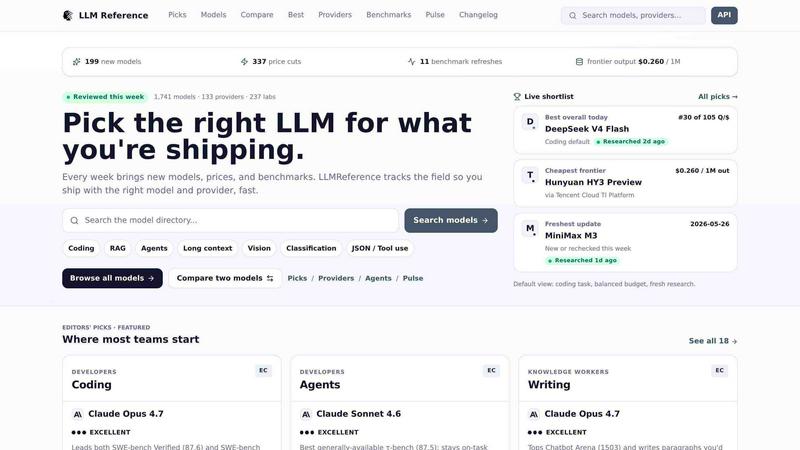
LLM Reference is a decision-support directory built for engineers and technology leaders who need to choose the right large language model (LLM) and provider in today's fast-moving AI landscape. It tracks over 1,800 language models from more than 140 providers and 247 research labs, with data refreshed weekly to include new releases, verified price changes, and benchmark updates. The core value proposition is simple: stop wasting time hunting through scattered sources and start shipping with confidence.
Whether you are building a coding assistant, an agentic workflow, a writing tool, or a research pipeline, LLM Reference gives you a single, trustworthy place to compare models side-by-side, see who offers the cheapest pricing for frontier output, and browse curated editors' picks for specific tasks like coding, agents, writing, research, image generation, and video creation. The site is designed for fast triage. You can quickly identify the right model for your job, determine the most cost-effective provider, and get back to building.
LLM Reference features a Pulse feed that highlights what changed this week, including new models, price cuts, and benchmark refreshes. It keeps you informed without the noise. The platform includes a model directory with search functionality, a provider directory, benchmark leaderboards, and a comparison tool. Editors' picks provide curated recommendations for common tasks, while the "Best of" boards show leaders across developer, knowledge worker, and creative categories. The site is built by the Data Advantage project and updated daily, making it an essential resource for anyone who needs to stay current with the exploding LLM ecosystem.
Features
Model Directory with Search
Browse over 1,800 language models from more than 140 providers and 247 labs. The searchable directory lets you filter by task type including coding, RAG, agents, long context, vision, classification, and JSON or tool use. Each model entry includes benchmark scores, pricing data, and provider details so you can make informed decisions quickly.
Editors' Picks for Specific Tasks
Curated recommendations from domain experts help you find the best model for your specific use case. Boards cover coding, agents, writing, research, image generation, and video creation. Each pick includes an excellence rating, key performance data, and a short rationale explaining why that model is the top choice for that task.
Pulse Feed and Weekly Updates
The Pulse section tracks what changed in the model market each week. You get a digest of new models added, verified price cuts from providers, and benchmark refreshes across major evaluation suites. This feature keeps you informed about the latest developments without requiring constant manual monitoring.
Model Comparison Tool
Compare two models side-by-side to see how they stack up across benchmarks, pricing, and capabilities. The comparison view surfaces key differentiators and helps you determine which model offers the best value for your specific requirements. This tool eliminates the need to open multiple tabs or cross-reference disparate sources.
Use Cases
Selecting a Coding Assistant Model
Engineering teams evaluating models for code generation can use the coding leaderboard and editors' picks to find the best option. For example, Claude Fable 5 scores 80.3% on SWE-bench Pro and 96% on SWE-bench Verified, making it a strong production coding pick. The platform surfaces these metrics alongside pricing to help teams balance performance and cost.
Choosing a Cost-Effective Provider for Frontier Output
Teams looking to minimize inference costs can use the frontier pricing tracker to find the cheapest provider for top-tier models. LLM Reference shows the lowest verified price per million output tokens, currently at $0.260 for Hunyuan HY3 Preview via Tencent Cloud TI Platform. This enables budget-conscious teams to deploy frontier capabilities without overspending.
Building an Agentic Workflow
Developers building autonomous agents need models that excel at tool use and self-correction. The agents leaderboard highlights Claude Sonnet 4.6 with a tau-bench score of 87.5, known for staying on-task across long tool loops. LLM Reference provides the data needed to select models optimized for agentic architectures.
Research and Knowledge Work
Knowledge workers and researchers can use the research leaderboard to find models that excel at complex analytical tasks. Claude Fable 5 leads with a GDPval-AA ELO of 1932 and strong performance in finance, trading, and analytics. The platform also provides writing recommendations for teams needing models that produce ship-ready prose with nuanced tone control.
Pricing
LLM Reference is a free resource available to all users. There are no subscription tiers, paywalls, or usage limits for accessing the model directory, comparison tools, editors' picks, leaderboards, or the Pulse feed. The platform is supported by the Data Advantage project and provided as a public resource for the AI community. All pricing data shown for individual models reflects the costs charged by the model providers themselves, not by LLM Reference.
Frequently Asked Questions
How often is the data on LLM Reference updated?
Data is refreshed weekly with new model releases, verified price changes, and benchmark updates. The Pulse feed highlights what changed each week, including new models, price cuts, and benchmark refreshes. The platform is updated daily by the Data Advantage project team.
How are the Editors' Picks determined?
Editors' Picks are curated by domain experts who evaluate models based on task-specific performance metrics, benchmark scores, and real-world usability. Each pick includes an excellence rating, key performance data, and a rationale explaining why that model is recommended for the given task. Picks are regularly updated as new models and benchmarks become available.
Can I compare two models directly on the platform?
Yes, LLM Reference includes a dedicated comparison tool that lets you evaluate two models side-by-side. The comparison view shows benchmark scores, pricing data, provider details, and capability differences. This tool helps you quickly determine which model best fits your specific requirements and budget.
What types of tasks are covered by the leaderboards?
The platform covers three main audience categories with six leaderboards each. Developers can find boards for coding, agents, tool use, open weights, long context, and cheap models. Knowledge workers have boards for writing, research, summarization, docs Q&A, translation, and data and SQL. Creatives can explore boards for image, video, voice, transcription, music, and image editing.
Similar to LLM Reference
Novastart
Infinite canvas whiteboard OS where apps, files, teams and AI agents work together.
Toolara Music
Describe a song in plain text and get a complete track — vocals or instrumental, custom lyrics, up to 120 seconds, MP3 download
ColdCrow
AI cold email writer with a deliverability score - describe a prospect, get a personalized draft in seconds.
LinkIntel
MCP server that gives Claude or any MCP assistant your own X post results and X's open-source ranking weights, so drafts start from evidence.

Verla AI
AI academic assistant for writing, research, presentations, and coding

RankAgent
AI SEO platform that tells agencies what to do next.
screenRIG
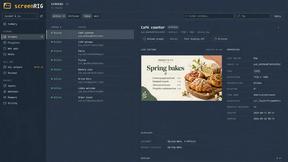
Signage and kiosk infrastructure for AI agents. Your agent publishes images, video, streams, web pages and apps to screens via one plugin.screenRIG is

NameSoul
Get a meaningful Chinese name — with its past-life story, clan totem, seal and brush calligraphy.