

Kompy
Kompy delivers Walmart price, stock, seller, and review data as clean JSON via REST API or MCP server for developers and AI agents.
AI tool Details
Explore More
Alternatives
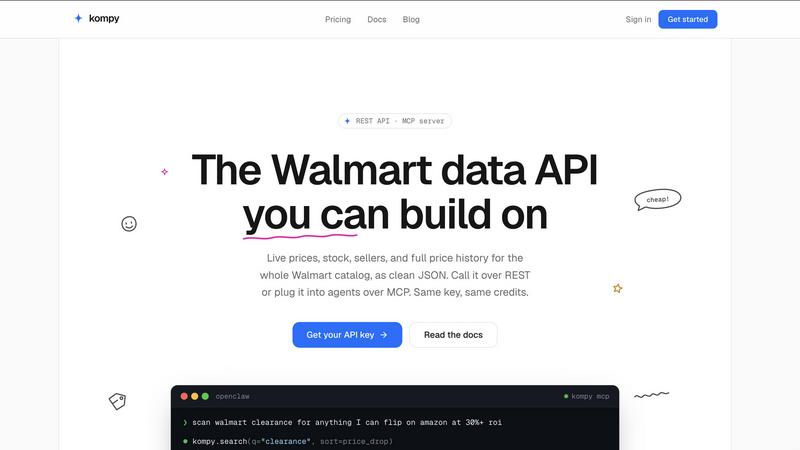
About Kompy
Kompy is a unified ecommerce data API that provides structured Walmart marketplace data without the need to run or maintain scrapers. It delivers clean, consistent JSON for products, search results, barcode lookups, seller offers, customer reviews, and full price and stock history. Designed for both human developers and AI agents, Kompy offers a dual-access approach: a standard REST API callable from any programming language, and a first-party MCP (Model Context Protocol) server that allows AI agents to query Walmart data directly as callable tools. The platform is built for speed and reliability, returning responses in milliseconds with deterministic schemas, small payloads, and structured errors. Kompy is ideal for developers building ecommerce applications, price monitoring tools, inventory management systems, arbitrage bots, and AI-driven shopping assistants. It serves a wide range of users, from individual developers and side project builders to professional teams and large organizations with custom integration needs. The platform features Google sign-in for instant account creation, immediate API key generation, and a credit-based pricing model that scales from small experiments to production-level workloads. Kompy records marketplace data around the clock, capturing hourly snapshots of price, stock, and buy-box changes for every SKU it tracks, with per-seller granularity and full historical data back to day one. This makes it the only Walmart data API that keeps comprehensive price history per seller. The service is not affiliated with or endorsed by Walmart Inc. but provides an independent, developer-friendly interface to access and analyze Walmart's vast product catalog.
Features
REST API with Clean JSON Responses
Kompy provides a straightforward REST API that returns predictable, consistent JSON shapes for every endpoint. No SDK is required to get started; developers can make plain HTTP requests from any language, including curl, Python, Node.js, and Go. Each response includes a unique request_id and latency measurement for easy tracing and debugging. The API covers all core operations: product details, search, barcode lookup, seller offers, reviews, and price history. This simplicity allows developers to integrate Walmart data into their applications with minimal setup and zero overhead.
MCP Server for AI Agents
Kompy ships a first-party MCP (Model Context Protocol) server that exposes all API operations as callable tools for AI agents. This means agents built with Claude Code, OpenClaw, Cursor, LangChain, OpenAI Agents SDK, n8n, or any other MCP-compatible stack can query Walmart data directly without writing custom integration code. The MCP server uses the same API key and credits as the REST API, providing a unified experience. Agents can search products, retrieve full product records, fetch price history, and get customer reviews as structured tool calls.
Full Price and Stock History
Kompy records the Walmart marketplace around the clock, capturing hourly snapshots of price, stock, and buy-box changes for every SKU it tracks. This historical data is available per seller, back to day one of tracking. No other Walmart API provides this level of granular historical data. Developers can query the history endpoint to analyze price trends, identify seasonal patterns, detect price drops, and understand seller behavior over time. This feature is critical for price monitoring, competitive analysis, and arbitrage opportunities.
Unified Search and Product Discovery
The search endpoint allows developers to query the live Walmart catalog with sorting and filtering capabilities. Results include full product records with price, stock status, seller information, ratings, and review counts. The search can be combined with other endpoints to create powerful data pipelines. For example, a developer can search for clearance items, then fetch price history for promising products, and finally analyze margins for resale opportunities. This unified approach eliminates the need to stitch together data from multiple sources.
Use Cases
Ecommerce Price Monitoring and Competitive Analysis
Businesses and developers can use Kompy to continuously monitor Walmart prices for their own products or competitor listings. By polling the product and history endpoints, they can track price changes in real time, detect when competitors lower prices, and adjust their own pricing strategies accordingly. The hourly snapshot data provides a complete picture of market dynamics, allowing users to identify trends, seasonal fluctuations, and pricing anomalies. This enables data-driven decision making for inventory management, promotional planning, and margin optimization.
Retail Arbitrage and Flipping Opportunities
Resellers and arbitrage hunters can leverage Kompy to find profitable flips between Walmart and other platforms like Amazon. By searching for clearance or deeply discounted items, then analyzing price history and current stock, users can identify products with significant price gaps. The MCP server integration allows AI agents to automate this entire workflow: scan for deals, calculate potential ROI, filter by margin thresholds, and alert the user when a profitable opportunity arises. This turns a manual, time-consuming process into an automated, scalable operation.
AI-Powered Shopping Assistants and Agents
Developers building AI shopping assistants or agentic applications can use Kompy's MCP server to give their agents direct access to Walmart's product catalog, pricing, and availability. An agent can answer user queries about product prices, compare options, check stock, and even monitor price drops over time. This enables natural language interactions where users ask questions like "Find me the best deal on a 65-inch TV under $500" and receive structured, actionable responses. The MCP integration makes this trivial to implement.
Inventory and Supply Chain Analytics
Retailers, distributors, and supply chain analysts can use Kompy to monitor Walmart's stock levels and seller activity for specific products. By tracking stock status changes and seller offers over time, they can identify supply shortages, detect new market entrants, and understand distribution patterns. The historical data allows for trend analysis and forecasting, helping businesses make informed decisions about procurement, logistics, and market entry strategies.
Pricing
Kompy offers three monthly subscription plans with credit-based usage. Every account starts with free credits upon signup, with no forced upgrade required.
Hobby plan at $49.99 per month includes 14,000 credits, API access, MCP server access, and email support. Ideal for individuals getting started with small projects or side experiments.
Pro plan at $149.99 per month includes 45,000 credits, API access, MCP server access, and priority support. Best for professionals and small teams running active monitoring or analysis.
Business plan at $499.99 per month includes 180,000 credits, API access, MCP server access, priority support, and custom integrations. Suitable for large teams with high-volume needs and specialized requirements.
Frequently Asked Questions
What is the difference between the REST API and the MCP server?
Both access the same underlying data and use the same API key and credit system. The REST API is a standard HTTP interface that returns JSON responses, suitable for any programming language or tool that can make HTTP requests. The MCP server exposes the same operations as callable tools for AI agents that support the Model Context Protocol, such as Claude Code, OpenClaw, and Cursor. You can use either or both depending on your workflow.
How do credits work and what counts as a credit?
Kompy uses a credit-based pricing model. Each API request consumes a set number of credits based on the endpoint and complexity. For example, a simple product lookup costs fewer credits than a full price history query. Credits are bundled into monthly plans and roll over? Check the specific plan details. Every new account starts with free credits to test the API without commitment. There are no hidden fees or forced upgrades.
What data does Kompy provide for each product?
For each product, Kompy returns the product ID, name, brand, current price, currency, stock availability, average rating, total review count, seller name, and a timestamp of when the data was captured. The search endpoint returns a list of matching products with these details. The history endpoint provides per-seller price and stock snapshots over time. The reviews endpoint returns individual customer reviews and ratings.
Can I use Kompy for commercial applications?
Yes, Kompy is designed for both personal and commercial use. The pricing plans scale from individual hobby projects to large teams with custom integration needs. The Pro and Business plans include priority support and higher credit limits suitable for production workloads. The terms of service allow commercial use as long as you comply with the usage guidelines and rate limits specified in your plan.
Similar to Kompy

LinkIntel
MCP server that gives Claude or any MCP assistant your own X post results and X's open-source ranking weights, so drafts start from evidence.

RankAgent
AI SEO platform that tells agencies what to do next.



ContextBolt SEO
Research keywords, competitors, backlinks and AI visibility inside Claude or Codex, with findings saved to your SEO dashboard.

GROWNX
Real-time downloads, revenue, and reviews across your App Store portfolio, plus an AI copilot.

Qoory
Intelligence engine for crypto and stock markets

CitedSpy
Track how ChatGPT, Perplexity, Gemini, Claude, and Copilot mention your brand, analyze citation sources, and outrank competitors in AI search.